Tuesday, September 8, 2020

New Journey, LBA Meetings, and Baptisms

 Wabash worship

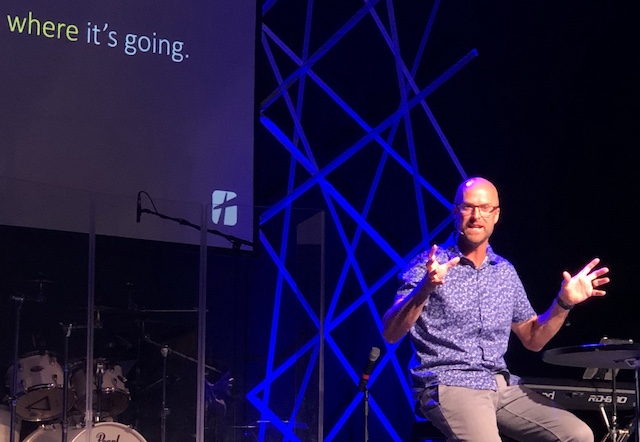
Sherry and I enjoyed worshiping with Rev. Rob and Melinda Tippey at Wabash New Journey Community Church on Sunday morning, August 30. In person attendance was strong again yesterday with many young families and several IWU students.  I had the privilege of installing Pastor Tippey on behalf of our Crossroads District team. Pastor Rob cast vision in an anointed message about "The Church I See" from Luke 14:25-33. He challenged the church with the reminder that "we're not here to fill seats, we are here to make disciples."

Wabash Preaching

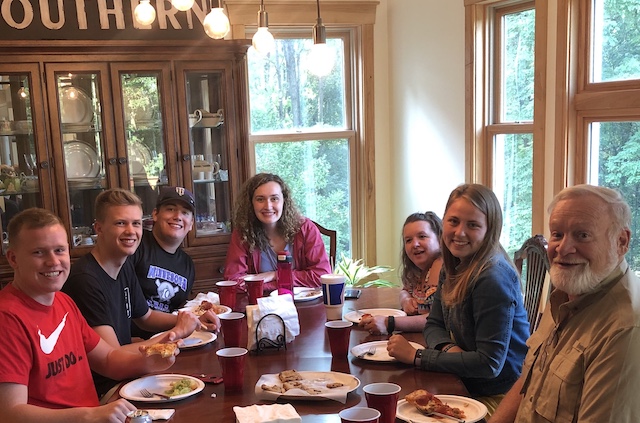
After the service, we joined the Tippey's and the young adults of the church for a delicious meal. New Journey was blessed to be launched by Pastors Tom & Sarah Cochran. Pastor Brian & Jessica Scramlin followed the founding pastors and built well on that foundation. Pray for Pastor Rob and Melinda as they lead New Journey into this next exciting chapter of impacting Wabash with the Gospel.

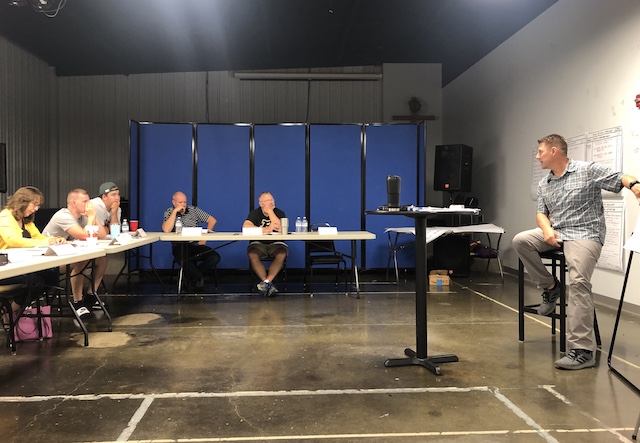
I connected with the Level 13 Church leadership team last Monday evening and confirmed interim ministry plans and their upcoming StratOp consultation with Jason Tash on October 2-3. Tuesday, I met with the Crossroads District team at Abbey Coffee in the morning. Sherry and I hosted the Hartford City Wesleyan Church staff for a meeting and supper at our place on Tuesday evening.

HCWC Staff at Thornapple

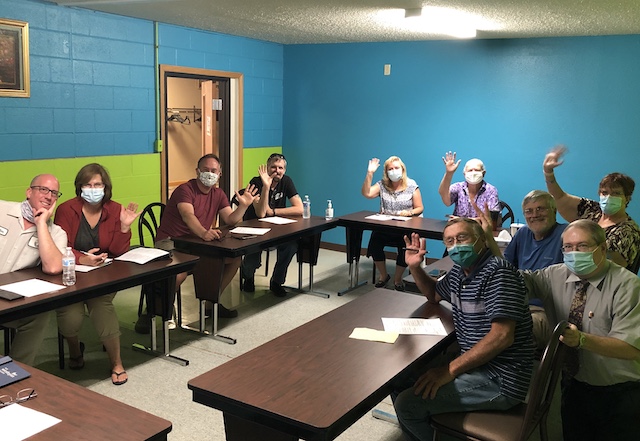
Wednesday included a flurry of calls, texts and emails. The best news of the day was the phone call from Pastor Mark Atkinson that he was being transferred to IU Health's Blackford Hospital so he can rehab closer to home. Wednesday evening, I met with the LBA at Gas City Eastview Wesleyan Church as they confirmed plans for the interim until Mark is healthy enough to return. They have a strong staff team that will be sharing the load for this vital ministry. While we were meeting, Pastor Mark sent us a photo via text so we returned the favor.

Eastview LBA

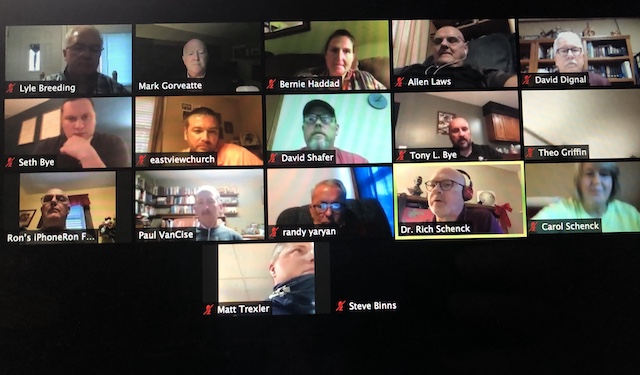
Thursday afternoon, I met with Dr. Mark Eckart via Zoom for an extended discussion about possible merits and models for more collaborative ministry between the Indiana South and Crossroads district. Mark continues to heal from a recent procedure on his vocal cords and is grateful for our prayers. Thursday evening, Seth Bye and I hosted a Zoom meeting for our pastors on communication they had received from the district office. The issue of effective ministry to persons who struggle with same sex attraction is a growing challenge in our congregations and colleges. Our aim is to minister with love and an optimistic view of God's grace that can empower people to live in freedom.

ZOOM Call

Friday, I dropped in Rev. Rick Carder and the DBMD Zone team that was meeting with ministerial candidates at Eastview Wesleyan Church in Gas City. The DBMD (District Board of Ministerial Development) plays a key role in helping individuals process their calling and walk with them as they prepare for a lifetime of vocational ministry. I am grateful for each of our ministers and lay leaders who collectively volunteer hundreds of hours each year to serve alongside our students in this significant assignment.

DBMD

Mr. Carl Shepherd led a group of us serving on subcommittee of the General Board in a Zoom meeting on Friday afternoon. The postponing of General Conference allowed for additional refinement of proposed memorials that will be considered by the board at its fall meeting. Carl and Vickie are actively involved at Indianapolis Trinity Church and Carl also chairs the IWU Board of Trustees. We're praying with Carl and Vickie as Vickie battles cancer.

Friday evening and all day Saturday, I served with Rev. Jason Tash as he led the Hartford City Wesleyan Church in a StratOp planning retreat. Jason is currently serving as VP for Development at Destiny Rescue but also graciously serves as part of our district team for these weekend consultations. The team at Hartford City Wesleyan Church worked well together in processing through the planning elements. Pray for HCWC as they move through this transition time and prepare to launch their pastoral search.

HCWC StratOp

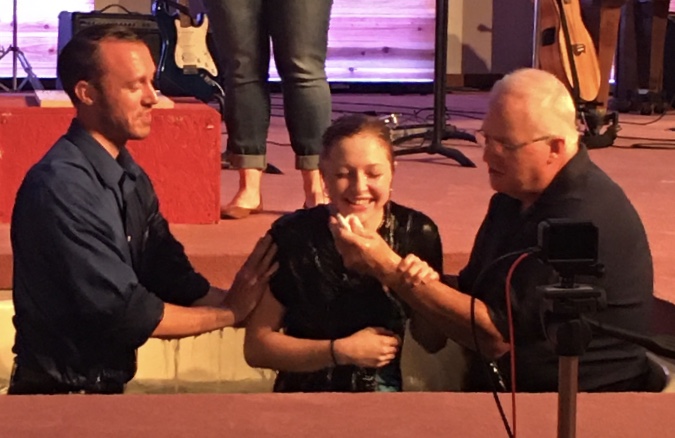
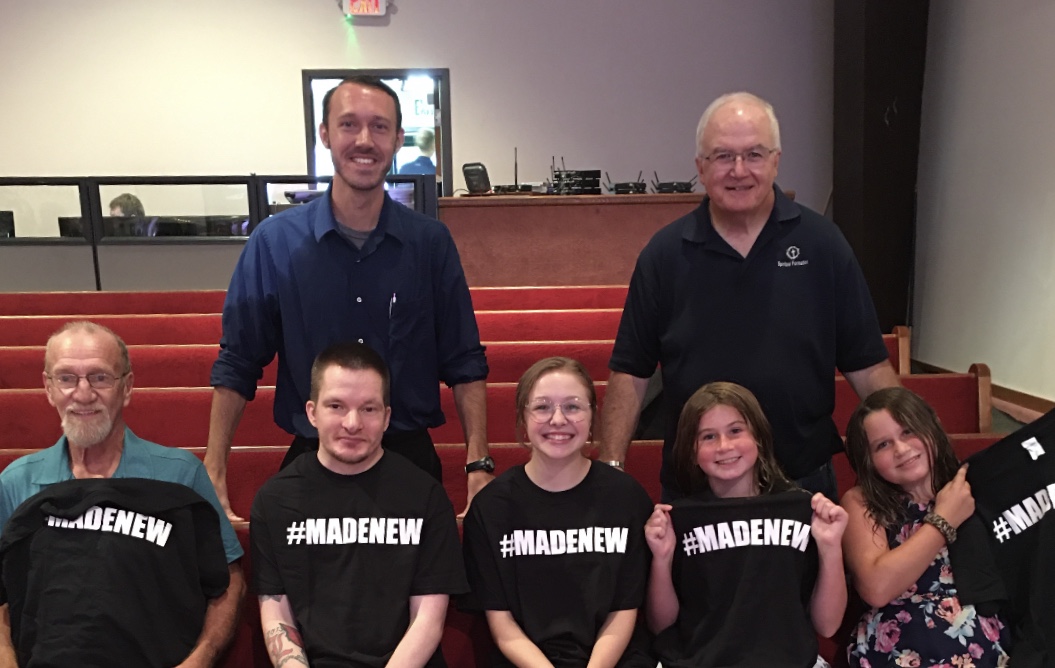
I am always excited to hear from our pastors with reports of changed lives and baptism celebrations. Pastor Lyle Breeding shared the good news that he and Assistant Pastor Lane Sander had the joy of baptizing 5 new believers at Sonlight Wesleyan Church in Bluffton. Praise the Lord for lives #madenew!

IMG_3724

IMG_3725

Rev. Aldean Pablo, our church planter in Roanoke/SW Fort Wayne reported 10 baptisms and more than 130 in attendance for an outdoor worship celebration this past Sunday at SEND Church in their cooperative ministry with the Sonrise UMC campus. Pastor Aldean had the special privilege of baptizing his son, Eleazar. Praise God for lives #madenew!

IMG_3727IMG_3729

Please continue to pray for healing grace to our pastors with physical concerns: Rev. Mark Atkinson (Gas City Eastview), Rev. Nicolas Zarate (Circle of Hope), and Pastor Steve Arnett (New Castle Mt. Zion).

Our sympathies and prayers are extended to the family and friends of Rev. Ray Hood, a retired minister who served for many years as pastor of Fishersburg Wesleyan Church. Rev. Hood passed away last week and his funeral will be held on Tuesday, September 1, at the Whetsel Funeral Service in Alexandria.

We believe that prayer makes a difference. We are inviting district pastors and lay leaders to join us for a concert of prayer at 6 p.m. on Sunday, September 20, at Lakeview Wesleyan Church in Marion. Dr. Jim Lo will be leading us in this prayer time with a special focus on revival in our churches. We would love to have you join us.

Keep on making a difference in the cause that counts for eternity!

Your servant in Christ,

Mark Gorveatte

Crossroads District Superintendent

Friday, June 15, 2012

Walking the Wire

I'm not sure all the exciting things you may have planned for this weekend, but it will tough to top what Nik Wallender has planned for this evening (Friday, June 15, 10:15 p.m.).


Nik was just six years old when he saw Niagara Falls for the first time.  Ever since then he has dreamed about walking across the chasm on a wire.  Now, twenty-seven years later, that dream is about to become a reality.


It's been done before but not since 1896, when Glover Cleveland was president. Famous funambulists such Jean Francois Gravelet (also known as “the Great Blondin”) and Maria Spelterini walked the gorge.  Blondin is best know for carrying his manager across on his back and Maria did it blindfolded. But, it's been more than 100 years since the last crossing, primarily because the various governmental agencies instituted "anti-stunting" regulations.


Now, after years of training, and months of lobbying the authorities for permission, Nik Wallenda has the opportunity to add his name to the list of high-wire legends. However, he won't be walking this tight-rope alone.


Nik is not only the seventh-generation Wallenda to master the art of tight-rope walking, he also walks with God.  Here are some of Nik's statements that you may not read in the main-stream media:


"I grew up in a born-again Christian family. A Bible-believing, God-fearing family. That's the way I was raised, and I find comfort and peace in that. It's the most important part of my life..."


"I believe in a thing called unmerited favor. It's undeserved, but God's involvement in my life has gotten me to where I am in my career."


"God's hand is involved in every step of my life..."


"I pray and I talk to God a lot and I find peace in that. That's how I can remain calm when people would think I could go nuts during this whole process."


All of us in ministry are called on to take risks.  Leadership inevitably brings us to crossroads where we have to decide again whether we're willing to put our resources, our reputation, our comfort, on the line.


No, your challenge may not be walking 1375 feet across a 2-inch wire with 400 million people watching, but leading is not for the faint of heart.


What's the biggest risk you've ever taken in ministry?  What giant step of faith is God placing before you for in this next season of leadership?


Nik didn't skimp on his planning and personal preparation, but he also reminds us about the power of prayer when we're facing a chasm that is not easily crossed.

In case you're wondering, I don't have anything quite this exciting planned for this weekend (or next), but I do have a few challenges ahead in leading an exciting ministry like Kingswood University (www.kingswood.edu).  Walking the wire in leadership keeps me continually grateful for God's unmerited favor and resting in His peace.


Thursday, June 14, 2012

Robert Quinn's definition of TEAM


Gary Hicks, another one of our many outstanding Kingswood University alumni, posted this definition of team on his Facebook page: “an enthusiastic set of competent people who have clearly defined roles, associated in a common activity, working cohesively in trusting relationships, and exercising personal discipline and making individual sacrifices for the good of the team.” – Robert Quinn in “Deep Change”

That's what we're working toward at Kingswood University.  I'd love for us to model this so well that our graduates move into their ministry assignments with a compelling picture of what it means to work together for the glory of God.  

How does your team do against this definition?

Sunday, November 20, 2011

Link to Kingswood University


http://kingswood.edu/index.php

Kingswood University: New Name - Same Mission

I'm excited to be part of this new chapter in a place that's meant so much to me and my family over the years. My parents met as students back in the 1950s while the college was still in Nova Scotia. I attended in the 1970s after the college had moved to Sussex, New Brunswick. Now, as we become Kingswood University, I'm blessed to have John and Josiah, my two older sons, attending. I really do believe our best days are ahead. I invite you to check out the website and learn more of the story of God's good work here at Kingswood University.

http://kingswood.edu/index.php


Tuesday, April 13, 2010

Tim Guptill on Core Philosphy at Crosspoint ...

Pastor Tim Guptill is doing a terrific job of leading Crosspoint (a Wesleyan church in Marysville, New Brunswick) to new levels of Great Commission effectiveness. I appreciated his recent blog posting and wanted to pass it along. Tim writes:

"I’ve done a few interviews recently with students from Bethany Bible College for their courses. One student this week asked me for a few of my ‘core philosophies of ministry’. Here is the list I gave him.

-The mission of every church is the same. Check Jesus’ words from Matthew 28. Go into all the world, make disciples, baptize them, etc.

-The vision is the unique calling and design of a church. It’s the way that God wants to use that church to reach its full redemptive potential.

-Most churches are doing far too much. The best thing they could do would be to refocus and stop trying to please everyone. Instead of doing a few things well, they do a lot of things average.

-Worship is about creating environments where people can experience the life-changing presence and message of Jesus.

-Worship (the entire service) done with excellence creates a culture of anticipation and expectation. Repeat that week after week and you won’t have to beg people to invite others, they just will.

-Never apologize for giving an invitation to accept Jesus.

-Spiritually mature people are more interested in lost souls than having their own personal preferences met.

-400 people can’t have everything their way. We all have to put the vision ahead of personal agendas.

-There is a fine line between faith and foolishness. I’ll take risk over regret every time."


Saturday, April 10, 2010

Classic Quote from Elton Trueblood

"All of the early Christians were missionaries. They did not leave the evangelistic task either to professional evangelists or to pastors to whom they paid salaries, for these did not exist... The early Church did not have a missionary arm; it was a missionary movement."
Elton Trueblood (1900-1994), The Incendiary Fellowship, New York: Harper, 1967, p. 11

Wednesday, November 25, 2009

Monday, October 12, 2009

In Canada, church clings to relevancy as congregations dwindle

Excerpt from October 10, 2009 article in National Post by Mohammed Adam (Canwest News Service)

http://a123.g.akamai.net/f/123/12465/1d/www.nationalpost.com/1010church.jpg Patryk Pigeon/Keystone Press

OTTAWA -- For 41 years, the Notre-Dame-de-Lourdes church was like a second home to George Laplante.

The Catholic church, which dates to 1873, was his spiritual foundation; the congregation, an extended family.

Now, Mr. Laplante, 68, is facing a harsh truth.

"It is sad, it is too bad, but that's the reality of life," he says of news that his Ottawa church will close by the end of this year. "The parishioners who go there cannot keep it going. Our church is fairly old. It is a big monument to look after. There's not enough of us to sustain it."

Mr. Laplante has attended Notre-Dame-de-Lourdes for 41 years. "I raised my kids in that church. Now it is me and my wife. I have to get used to going to another place."

What's happening at Notre-Dame-de-Lourdes-de-Cyrville is a symptom of a larger malaise. Shrinking congregations and spiralling costs are fuelling the decline of the traditional church.

Father Daniel Berniquez, episcopal vicar of the French sector of the Ottawa archdiocese, says churches that once drew 400 to 500 people now attract about 40.

"Fifty years ago, most people went to church," says Mr. Berniquez.

"But that reality has changed. There's less people going to church. It is true for the Catholic church, but it is also true of other denominations."

During the past two years, about 20 churches of various denominations have closed or are slated to close in the area around Ottawa and Gatineau, Que.

Across the country, the United States and Europe, changing demographics, shifting values and growing secularism are taking a toll.

In a British report published two years ago, an independent organization called Christian Research said thousands of churches are closing for lack of practising Christians.

It said more churches are closing than opening. In a warning to church leaders, it predicted that by 2040, 18,000 churches in England will close.

Closer to home, experts say Quebec -- where the Catholic Church once called the shots in public and private life -- stands to lose about half of its 2,000 churches by 2016.

As the mainstream religions wither, the evangelical and Pentecostal denominations are packing in millions of worshippers who seem to have discovered a new path to God.

While the traditional church is still the dominant player in Canada, experts say it must adapt or it will become irrelevant, or die.

"For Catholicism to rely strictly on tradition as though it were bricks at a construction site that you hand over from person to person and generation to generation, that's dead," says Christophe Potworowski, the Kennedy Smith chair of Catholic studies at McGill University.

"There has to be an examination of conscience to see if the church is doing something wrong. A tremendous amount of flexibility in responding to changing circumstances is required."

Father Luc Tardis, rector of the Saint Paul University seminary, agrees.

"Traditional religion has to modify its relationship with the public and with cultural life," Mr. Tardis says.

He notes that not everyone thinks churches respond to their needs or sensitivities. "The big issue is: How much creativity can we bring in to become more relevant for people?"

The numbers show that Canadians have been fleeing the church for decades. In the mid-1940s, about 67% of adult Canadians attended church weekly.

By 1985, the number had plunged to 30%. In 2005, the number hit 20%. In 2006, a Canwest News Service poll found that 17% of Canadians attend church at least once a week, even though about half of those surveyed said they believe in God.

More worrying for churches is the number of young Canadians who are turning their back. In a sweeping study last year by renowned Canadian sociologist Reg Bibby, 47% of the teenagers surveyed said they never go to church. Another 20% said they "hardly ever go," while 21% said they go weekly.

Experts are quick to caution that it does not mean Canadians have given up on faith.

Potworowski suggests it instead reflects a rejection of "organized religion."

Mr. Tardis agrees, but says underlying it all, is a seismic shift in mentality, spirit and values. "People now will say, ‘I am spiritual but not religious.' They will say, ‘I have my own relationship with God and that's it. They have no need or desire to live the religious experience with others, as was the case before."

Unlike today's generation, the early European immigrants, who built many of the churches, found strength and purpose in religion. Attending church on Sunday was a time-honoured tradition. They showed their faith by filling the pews and emptying their pockets.

As older generations passed on, they left behind gaps in the pews and fault lines in church foundations. Their children drifted from the church as values changed, fortunes improved and new interests took hold. Immigration patterns were also changing: A majority of new arrivals were from Asia, the Middle East and Africa, and they practised Islam, Hinduism and Sikhism -- religions that have grown exponentially.

But while traditional churches struggle, new ones are thriving because they've shed rigid dogmas and proclaimed, in the words of one pastor, that the church should be a "hospital for the hurting, not a museum for saints."

Mr. Tardis says Pentecostals can teach the Old Church a thing or two.

"There is a quality of fraternity, spirit of community and warmth that is very attractive," he says. "They have a spiritual fervour, a kind of zeal and passion for God that is expressed in a very charismatic and spontaneous manner, and it pleases people."

Sunday, October 11, 2009

Church: Love It, Don't Leave It

Adam Lipscomb referred to this guest column in the Washington Post

Church: Love It, Don't Leave It

By Kevin DeYoung and Ted Kluck

Here's what Bono, Oprah, and the guru speakers on PBS won't tell you: Jesus believed in organized religion and he founded an institution. Of course, Jesus had no patience for religious hacks and self-righteous wannabes, but he was still Jewish. And as Jew, he read the Holy Book, worshiped in the synagogue, and kept Torah. He did not start a movement of latte-drinking disciples who excelled in spiritual conversations. He founded the church (Matt. 16:18) and commissioned the apostles to proclaim the good news that Israel's Messiah had come and the sins of the world could be forgiven through his death on the cross (Matt. 28:18-20; Acts 2:14-36).

For almost two millennia, it was axiomatic that Christians, like, actually went to church (or at least told other Christians they did). From Cyprian to Calvin it was believed that for those to whom God "is Father the church may also be Mother." But increasingly Christians are trying to get more spiritual by getting less church.

Take a spin through the religion section at your local bookstore. What you'll find there is revealing - there are "revolutionary" books for stay at home moms, teenagers, and Christian businessmen. There are lots of manifestos. And most of the books about church are about people leaving the church to "find God." There are lots of Kerouacian "journey" stories, and at least one book about the gospel according to Starbucks. It used to be you had to overthrow a country to be considered a revolutionary, and now, it seems, you just have to quit church and go pray in the woods.

We've been in the church our whole lives and are not blind to its failings. Churches can be boring, hypocritical, hurtful, and inept. The church is full of sinners. Which is kind of the point. Christians are worse than you think. Our Savior is better than you imagine.

But the church is not all about oppression and drudgery. Almost every church we know of visits old people, brings meals to new moms, supports disaster relief, and does something for the poor. We love the local church, in spite of its problems, because it's where we go to meet God. It's not a glorified social/country club you attend to be around people who talk and look just you do. It's a place to hear God's word spoken, taught and affirmed. It's a place to sing praises to God, and a place to serve others. It's a place to be challenged.

The church is more than plural for Christian. It is both organism and organization, a living thing comprised of a certain order, regular worship services, with doctrinal standards, institutional norms, and defined rituals. Without the institution of the church nurturing the flock and protecting the faith for two thousand years, there would be no Christianity. If Gen Xers (like us) and their friends want to be against something, start a revolution. If you want to conserve truth and grace for twenty centuries, plant a church.

We love the church because Christ loved the church. She is his bride--a harlot at times, but his bride nonetheless, being washed clean by the word of God (Eph. 5:25-26). If you are into Jesus, don't rail on his bride. Jesus died for the church, so don't be bothered by a little dying to self for the church's sake. If you keep in mind that everyone there is a sinner (including yourself) and that Jesus Christ is the point and not you, your dreams, or your kids, your church experience might not be as lame as you fear.

Perhaps Christians are leaving the church because it isn't tolerant and open-minded. But perhaps the church-leavers have their own intolerance too--intolerant of tradition, intolerant of authority, intolerant of imperfection except their own. Are you open-minded enough to give the church a chance--a chance for the church to be the church, not a coffee shop, not a mall, not a variety show, not Chuck E. Cheese, not a U2 concert, not a nature walk, but a wonderfully ordinary, blood-bought, Spirit-driven church with pastors, sermons, budgets, hymns, bad carpet and worse coffee?

The Church, because it is Christ's church, will outlive American Idol, the NFL, and all of our grandkids. We won't last, but the Church will. So when it comes to church, be like Jesus: love it, don't leave it. As Saint Calloway once prophesied to the Brothers of Blues, "Jake, you get wise, you get to church."

Kevin DeYoung is senior pastor at University Reformed Church in East Lansing, Michigan. He serves on the executive team of RCA Integrity, a renewal group within the Reformed Church of America. Ted Kluck's work has appeared in ESPN the Magazine, Sports Spectrum Magazine, ESPN.com Page2, and several small literary journals.

They are the authors of the new book Why We Love the Church: In Praise of Institutions and Organized Religion.

Friday, October 2, 2009

LEADERSHIP: 10 TOUGH QUESTIONS TO ANSWER

Here are 10 tough questions managers need to ask themselves, according to information technology executive Phil Gerbyshak on the Slacker Manager blog:

* Why am I doing what I am doing?
* Is my team still doing work that is valued?
* How does my daily work contribute to the firm's bottom line?
* How can I do more that is more meaningful to the business?
* How can I do less of what isn't meaningful?
* Is what I'm doing right now helping or hindering my team's growth?
* Is there a better way to do this task?
* How can I reward this team for doing the great work they're doing?
* What new skills do I need to learn and what skills do I need to teach my team?
* Do the right people know the value my team brings to the table?

Friday, September 25, 2009

Newer churches baptize new believers at higher rate

Will McRaney's research of Southern Baptist Convention baptism rates found the following:

Years in Existence compared to # of Baptisms per 100 worship attenders

0-2 years / 14.4 baptisms per 100 in worship
3-15 years / 9.1 baptisms per 100 in worship
16 or more years / 7.3 baptisms per 100 in worship

Newer churches have significantly higher rates of believer baptisms than established churches.

Source: Journal for Baptist Theology and Ministry, Vol. 1, No. 2 (Fall 2003), pages 69-95


Thursday, July 9, 2009

Individual Salvation "Heresy"?

Episcopal Bishop calls individual salvation 'heresy,' 'idolatry'
Associated Press - 7/9/2009 5:35:00 AMBookmark and Share

Associated Press smallEpiscopal Church logoANAHEIM, CA - Episcopal Presiding Bishop Katharine Jefferts Schori says it's "heresy" to believe that an individual can be saved through a sinner's prayer of repentance.

In her opening address to the church's General Conference in California, Jefferts Schori called that "the great Western heresy: that we can be saved as individuals, that any of us alone can be in right relationship with God."

The presiding bishop said that view is "caricatured in some quarters by insisting that salvation depends on reciting a specific verbal formula about Jesus."

According to Schori, it is heresy to believe that an individual's prayer can achieve a saving relationship with God. "That individualist focus is a form of idolatry, for it puts me and my words in the place that only God can occupy."

Monday, June 15, 2009

Nazarenes Approve "Real-Time" Budget Assessment

According to the HolinessToday website, the Church of the Nazarene approved a new budget formula.

"The Budget Formula
The Board of General Superintendents also voted in December 2008 to recommend a new World Evangelism Fund (WEF) allocation formula of 5.5 percent for the entire global Church of the Nazarene.

"This proposed global formula is based on current year income and no deductions. This is intended to create greater global ownership, participation, and support of the WEF—in addition to giving within the regions for special missional projects.

"In addition, the Board of General Superintendents is recommending the following formula for the U.S.:

Proposed U.S. Budget Formula
World Evangelism Fund (WEF)5.5 %
Pensions & Benefits (P&B) Fund2 %
Education2.5 %
DistrictDetermined by district

"The U.S. formula will take effect with the 2010 district assemblies. It, too, is based on current year income and no deductions.

"District budgets in the U.S., which are a vital part of the mission funding of the church, will be in addition to these categories and percentages. Each district will set its own budget, based on district missional priorities. It should be noted that the Board of General Superintendents does not have authority to determine district budgets.

"These four budgets—WEF, P&B, Education, and District—form the core of local church mission and connectional giving in the U.S.

"The previous formula, which was the subject of much discussion and review for some time, was based on complex calculations determined by the previous year's expenditures in the local church. The new formula is determined by a simple and straightforward percentage of current income.

"One objective in this change is to leave more money in the local church for ministry."

Will the Wesleyan's be far behind in moving to a "real-time" current income assessment model? It was proposed at General Conference 2000 (Memorial #348,page 83).


Wednesday, June 3, 2009

Goal Setting: Andy Rowell's Pros and Cons

I appreciated Andy Rowell's blog on the upsides and downsides of goal setting for ministers. What's your take on this? Are you a goal-setting fanatic or do you prefer freestyling?

Why pastors should be both goal-setting fanatics and cynics

I decided to post this again because today I came across a vigorous debate in the business world about "goal setting gone wild." The post below originated as a lecture to Christian ministry students at Taylor University about the benefits and dangers of goal setting.

Original post: June 24, 2006

319512_2478

Part I: Four reasons why goal-setting is indispensable to pastoral ministry:

1. Without clear goals, we will often end the day having accomplished nothing important.

The youth pastor textbook Youth Ministry Management Tools includes this nugget of wisdom:

“You’re almost guaranteed trouble if you come to the office without a plan for the day. It’s amazing how time slides by and, to your dismay, you discovered you haven’t accomplished anything close to six hours’ worth of results from your day’s activities. Ministry is not about us simply putting our time in at the office” (Ginny Olson, Diane Elliot, and Mike Work, Youth Ministry Management Tools. Grand Rapids: Zondervan, 2001. p. 73).

Without thinking through goals, we will have no criteria by which to sort through the demands upon us. We will need to instantly analyze whether we should do what someone asks us to do. These rushed decisions will produce mistakes. I often feel angry at myself for not accomplishing more in a given day.

2. Without clear goals, our fellow workers in ministry will not know which direction we are going.

Have you ever tried to “caravan” – drive with a number of different vehicles to the same location? What happens is that people have to go through red lights to keep up with each other. The lead car often has to pull over in unsafe places for the other vehicles to catch up. Safety experts say the safest approach is to give each car a set of directions and to communicate by cell phone if someone gets lost. In the same way, it is very difficult for our fellow workers to keep up with us if they don’t know where we are going. It is better to give them the map ahead of time. Marcus Buckingham and Curt Coffman, authors of the book First, Break All the Rules: What the World's Greatest Managers Do Differently (Simon & Schuster, 1999) which is based on 80,000 interviews, believe one of the most important things managers can do is “define the right outcomes” for the people they are working with. We don’t need to supervise every little detail someone is doing if we have described to them the final destination.

3. It makes sense to focus on a few things because we can’t do everything.

Rick Warren gives this illustration in his book The Purpose-Driven Church: Growth Without Compromising Your Message & Mission (Zondervan, 1995, p. 157).

“Imagine what would happen to a commercial radio station if it tried to appeal to everyone’s taste in music. A station that alternated its format between classical, heavy metal, country, rap, reggae, and southern gospel would end up alienating everyone. No one would listen to that station!”

Pick something and do it well. Every 6 months, I need to articulate a new set of challenges to keep me motivated. You probably will too. I often list a whole bunch of ideas and then have someone help me to narrow them down to a few that I should focus on.

4. With clear goals, extraordinary things are possible.

Practice makes perfect. It really does. If you work at something steadily, you can accomplish extraordinary things.

Anders Ericsson’s work, “compiled in the The Cambridge Handbook of Expertise and Expert Performance, a 900-page academic book that was published last month [June 2006], makes a rather startling assertion: the trait we commonly call talent is highly overrated . . . ‘I think the most general claim here,’ Anders Ericsson says of his work, ‘is that a lot of people believe there are some inherent limits they were born with. But there is surprisingly little hard evidence that anyone could attain any kind of exceptional performance without spending a lot of time perfecting it’” (Stephen J. Dubner and Steven D. Levitt, “Freakonomics: A Star Is Made,” NY Times Magazine, May 7, 2006). See also How to Grow a Super Athlete in Play Magazine, February 2007.

When I was a kid, I wanted to be a major league baseball player. I loved throwing a ball against the back of our house. It would bounce back to me and I would practice fielding it. I would even try to throw the ball to my right and left and practice diving plays. I did this thousands of times. From the time I was six, I was known as a good infielder. The more I was affirmed, the more I practiced. I ended up playing baseball through college. On the other hand, I disliked playing the piano. I would practice the 15 minutes per day that my mother required but not one minute more. Because of my minimalist approach to practice, my recitals were traumatic. I was always surprised at how badly I did. When I would sit up there on stage, I would expect to do well but I would always get lost and mess up. The point is simple: what we like to do, we do often and thus get good at it.

Pastoral theology author Eugene Peterson entitled one of his books, A Long Obedience in the Same Direction: Discipleship in an Instant Society (InterVarsity, 2000), based on Friedrich Nietzsche’s quote which reads: "The essential thing in heaven and earth is . . . that there should be a long obedience in the same direction; there thereby results . . . something which has made life worth living" (Beyond Good and Evil, 1907, section 188.)

When I reflect on these reasons for goal-setting, I am inspired to dream a little. What do I want my life to look like in 10 years? What kind of person do I want to be? What do I hope my ministry is doing? . . .

Now, how can I break that end goal into small parts? And what can I do today to take a small step toward those goals?

Goal-setting keeps us focused, effective, inspired, and fruitful. Four cheers for fanatical goal-setting. And now . . . why we should be very suspicious of goal-setting.

Part II: Four reasons why we should be suspicious of goal-setting in pastoral ministry:

1. We are often fooling ourselves to try to set long term goals.

“Precise long range planning isn’t difficult. It’s impossible!” says Jim Plueddemann, professor of missions at Trinity Evangelical Divinity School at his blog. My 21 year old students often have trouble picturing what ministry they will be doing in ten years. I’m sympathetic to them because I don’t know either. I like being a pastor and being a professor. Will I be doing one or the other or both or neither in ten years? What should I be planning for?

Consider again Rick Warren’s quote that we cited above.

“Imagine what would happen to a commercial radio station if it tried to appeal to everyone’s taste in music. A station that alternated its format between classical, heavy metal, country, rap, reggae, and southern gospel would end up alienating everyone. No one would listen to that station!” (The Purpose-Driven Church: Growth Without Compromising Your Message & Mission. Zondervan, 1995, p. 157).

What Warren does not say is that there are huge ramifications when one narrows one's audience--many which are unintended. [I have written more about Warren's approach at: A wider target: Deconstructing and redeploying the Seeker Sensitive Service planning of The Purpose Driven Church and Strengths of the Purpose Driven Church and Sober Advice For Those Considering the Megachurch]. When we specialize too quickly, we may miss the richness of learning a bit about the other genres of music. People donate to NPR (National Public Radio) stations precisely because they are not driven by commercial interests but rather play a variety of jazz, classical, news and talk in an attempt to edify the listener.

When a church decides to “target” ministry to married upper-middle class businessmen, often the poor (or “underresourced”), single, and disabled are subtly treated as inconvenient to the programming. A church may be better off intentionally having a more general focus.

Similarly, a student may be better off cultivating a number of ministry skills in a small church (including teaching, administration and pastoral care to a variety of age groups) as opposed to immediately specializing in a large church by being the director of small groups to single men who are between the ages of 21 and 25.

Setting goals helps us to focus and narrow down. But sometimes intentionally keeping a broad scope reflects the fact that we cannot know the long-term. Sometimes it is better to keep our options open.

2. Goals that focus on the A, B, C’s, (attendance, buildings and cash) are not God’s primary goals.

I tease my students that anyone can come up with an instant “vision” for any ministry. If they say they are interested in inner-city basketball ministry, I say: “I have a vision of (a) thousands of kids streaming into a (b) gorgeous 20-court basketball facility in downtown Chicago and (c) hundreds go to college with money donated by NBA players.”

Another student is interested in family wilderness ministry. I immediately throw out a “vision” of (a) thousands of families going to a (b) 500,000 acre park where they can whitewater raft and mountain climb and (c) there is a staff of 300 full-time trained Christian guides.

In each case, I am illustrating that anyone can articulate “a vision” in terms of attendance, buildings and cash. Jim Plueddemann says it this way: “If you have precise, predictable goals you are aiming at something of secondary importance.” There is nothing wrong with these ABC goals but we must realize that they are secondary. Pluddemann goes on to say: “The most important goal is to glorify God and help others come to Christ and progress in their pilgrimage toward Christlikeness. Such goals are imprecise.” Glorifying God and helping people grow in him are our primary goals. It is also difficult to precisely measure them.
Therefore, if we have accomplished our ABC vision, but have not glorified God, we have not accomplished anything. If our goals are ABC-oriented, let’s make sure they don’t get in the way of our primary goals.

3. Written vision statements are overrated. You can still have vision without them.

Thom Rainer did a study of churches that went from “good to great.” He calls these churches “breakout churches.” He and his researchers found that formal “goal-setting” and “strategic-planning” processes did not play a role in these churches becoming more effective.

“Our research team did not hear any of the leaders of the breakout churches mention any efforts to discover vision. Yet they all have a clear and compelling vision today . . . What these thirteen churches had in common was a vision that ‘discovered’ them rather than a painful search to find out God’s specific plan . . . The Vision Intersection Profile is when the Leadership’s Passion, Community’s Needs, and Passion/Gifts of the Congregation intersect” (Thom Rainer, Breakout Churches: Discover How To Make The Leap. Zondervan, 2005. pp.112, 113, 114).

Some people are already focused and inspired. They don’t need some goal-setting mechanism to get them going. These bureaucratic processes can sometimes drain energy from the really passionate people instead of inspiring the unfocused. Writing down your personal goals or articulating a mission-statement may actually lead to a subtle feeling that the work is now over!

“We found a lack of written vision statements among the breakout churches. Conversely, we found written vision statements in more than 70% of the comparison churches. The leaders of the comparison churches seem to think that, if they could just get an idea in writing before the congregation, the people would follow. The breakout leaders discovered vision long before any statements were written, if they were ever written.” (Thom Rainer, Breakout Churches. p.115).

4. It is more important to fan your passions and riskily attempt action than to articulate your goals.

Tom Peters, author of the book In Search of Excellence: Lessons from America's Best-Run Companies, writes:

"Plans? Goals? Yes, I admit that I plan and set goals. After I’ve accomplished something, I declare it to have been my goal all along. One must keep up appearances: In our society “having goals” and “making plans” are two of the most important pretenses. Unfortunately, they are dangerous pretenses -- which
repeatedly cause us to delay immersion in the real world of happy surprises, unhappy detours, and unexpected byways. Meanwhile, the laurels keep going to those mildly purposeful stumblers who hang out, try stuff with reckless abandon-- and occasionally bump into something big and bountiful, often barely related to the initial pursuit” (Peters, T. The Bookstore Journal. Feb. 1991 quoted by Plueddemann).

The secret of an effective life is not how to do SMART goals (Specific, Measurable, Achievable, Realistic, Timely). Rather, it is closer to what Rainer discovered in studying great church leaders.

“Breakout church leaders understand the incredible brevity of life. They desire to make a difference for the glory of God in this short period. And they trust in a God of miracles for whom all things are possible” (Thom Rainer, Breakout Churches. p.127).

Conclusion:
So do we set goals? Yes! We use goal-setting to keep us focused, effective, inspired, and fruitful. But goal-setting must be done with humility, depth, passion and trust.

This should be our prayer. God, show me what kind of person you want me to be in 10 years. God, show us what kind of church you want us to be in 10 years. We want to glorify you. We want to see people grow to know you more. We will risk because we trust you. What step do you want me to take today?

Update May 20, 2009
There was a lively debate about goals in
The Academy of Management Perspectives
Issue: Volume 23, Number 1 / 2009
(Not available for free online).

There were two dualing articles:

"Goals Gone Wild: The Systematic Side Effects of Overprescribing Goal Setting" pp. 6 - 16
Lisa D. Ordóñez, Maurice E. Schweitzer, Adam D. Galinsky, Max H. Bazerman

"Has Goal Setting Gone Wild, or Have Its Attackers Abandoned Good Scholarship?" pp. 17 - 23
Edwin A. Locke and Gary P. Latham

Now you can read one of the camps' response.

"On Good Scholarship, Goal Setting, and Scholars Gone Wild"
Lisa D. Ordóñez, Maurice E. Schweitzer, Adam D. Galinsky, Max H. Bazerman
Harvard Business School Working Knowledge
Working Paper 09-122

This group wants to be cautious about goal-setting. Here are two good quotes from their working paper.

"There is mounting causal evidence linking goal setting with a range of behaviors including a shift in risk taking (Larrick, Heath, & Wu, in press), greater unethical behavior (Schweitzer, Ordóñez, & Douma, 2004), and a narrow focus that draws attention from other important elements of the problem (Staw & Boettger, 1990)." p. 5

"As financial crises, Ponzi schemes, and the collapse of the automotive industry demonstrate, the combination of unethical behavior, risk-taking and poor judgment can be toxic. We are not implying that goal setting was the primary cause of the current crises. Instead, we suggest that we should develop and sharpen our understanding of those contextual factors that produce harmful behaviors." p. 8

Tuesday, June 2, 2009

Pastor Bill Kinnan & Linwood Wesleyan on the Edge!

Church Planting is What Linwood Does (article online at www.wesleyan.org)

Jun. 1, 2009

"Church planting is not something we've done. It's what we do."

The words of Bill Kinnan, senior pastor at Linwood Wesleyan Church in Sioux Falls, South Dakota, are still true today, ten years after their first church plant.

Celebrate Church was launched in 1999 and is now one of the fastest growing in The Wesleyan Church. In March 2009, Linwood planted another church in Sioux Falls and in just two months, average attendance at The Ransom is over 100.

Phil Wiseman left his position as Linwood worship arts pastor because he felt led to find a secular job and serve as a volunteer at The Ransom.

"When Phill [Tague] and [his wife] Stephani came to Linwood with the intentions of planting a new church, I was taken back to the excitement and passion I felt when I was first called into the ministry," says Phil. "My desire to see the broken and forgotten of the world reached with the gospel resurfaced in a really cool way, and I felt this desire to go help this church plant in whatever way I can."

After praying for several weeks about going, Phil and his wife Natalie made the move. Phil works part-time in a secular job and also serves part-time at the church alongside Lead Pastor Tague (see photo).

Even in a short time, Pastor Tague has seen God move mightily in the brief time The Ransom has been established.

"We are seeing the un-churched come to Christ and the churched recommit their lives to Christ," says Pastor Tague. "God is also sending us many who come from broken backgrounds, like those who are struggling to overcome addictions. Our vision is setting captives free, and we are seeing God do this not only on the spiritual level but on the physical and emotional too."

The church's name stems from the vision God gave Phill and Stephani. As they began to pray for a name that would fit, song lyrics from a well-known worship song seemed ideal: "My chains are gone, I've been set free; my God, My Savior has ransomed me." The Tagues then knew the church would be called The Ransom.

So far at The Ransom, close to a dozen individuals have prayed and received Christ.

Linwood "gets it honest" when it comes to church planting. The church itself is a plant that began in 1966, and today average attendance totals more than 500. The church also sets aside money each year in the annual budget that goes specifically toward church planting.

Wednesday, May 27, 2009

Michigan leads the Nation ... in population decline

Utah was the nation’s fastest-growing state between July 1, 2007, and July 1, 2008, as its population climbed 2.5 percent to 2.7 million, according to estimates released today by the U.S. Census Bureau.

Arizona was the second fastest-growing state, increasing 2.3 percent between 2007 and 2008. Texas, North Carolina and Colorado completed the top five, each with a growth rate of 2.0 percent. Nevada, which had been among the four fastest-growing states each of the last 24 years, grew 1.8 percent and ranked eighth over the most recent period.

     Texas gained more people than any other state between July 1, 2007, and July 1, 2008 (484,000), followed by California (379,000), North Carolina (181,000), Georgia (162,000) and Arizona (147,000).

     The only two states to lose population were Michigan and Rhode Island. Michigan’s population declined 0.5 percent (46,000), while Rhode Island’s fell 0.2 percent (2,000).

Tuesday, March 31, 2009

Isn't "50" just half-time?


Well, it's started. Looks like some fun is ahead as I approach the magnificent milestone of the big "50." Half a century. Is this the middle of middle age?

The first e-mail of what may be numerous and similarly humorous e-mails came through this morning from Chad McCallum. Thanks Chad!

"Mark – thinking of you this morning as you approach the proverbial summit of your life…

I have been thinking of some hymns for the over-50 crowd (now that you are soon to be numbered among that number)…

1. “Precious Lord, Take my Hand, and Help Me Up”

2. “It is Well with my Soul; but my Knees Hurt”

3. “Nobody Knows the Trouble I have Seeing”

4. “Go Tell it on the Speed Bump”

5. “I Love to Tell the Same Story”

6. “Just a Slower Walk with Thee”

7. “Guide me, O Thou Great Jehovah, I’ve Forgotten where I Parked”

Here is to another 50 years of life and ministry! In the words of George Burns, “If you live to be one hundred, you've got it made. Very few people die past that age!”

Blessings on my friend!

Chad"

Monday, March 23, 2009

Trailing at the Half ...but Prevailing!


Knowledge @ Wharton posted this insightful article (March 18, 2009) on comeback victories:

"According to recent research by a pair of Wharton professors, teams that trail by a little at the half actually have a better chance of winning the game than the squad in the lead.

Wharton marketing professor Jonah Berger and Devin Pope, a professor of operations and information management, found that teams which were slightly behind at the half won more often than they lost. Their research paper, which is based in part on the results of more than 6,000 recent college basketball games, is titled: "When Losing Leads to Winning."

But Berger noted that these findings could just as easily apply to the workplace, because they suggest that employees -- like basketball players -- should be more motivated and thus perform better when they are close to, but just short of, an important goal.

"Take any situation where someone is so close to a goal that they can almost taste it," Berger noted. "The fact that they're almost there makes them work harder." Thus, in the corporate world, where goal setting is an important management tool, Berger said it's a good strategy to pick milestones that are within reach, such as passing a close competitor in sales.

Focusing on goals that are close and achievable may be more motivating than lofty but unrealistic goals, according to Berger. "You want to pick a target that's close, where you are almost there but not quite."

Pope, his co-author, elaborated: "A lot of tools are used in the workforce to motivate people, such as wages, bonuses, etc. While surely these things can have motivating effects, one should not underestimate the potential importance of psychological motivation as well. This paper shows that the psychological impact of being behind by a small amount can cause significant increases in performance."

Motivational behavior is not Berger's usual academic focus. Usually, he delves into topics such as social contagion, viral marketing and decision-making issues like those explored in Malcolm Gladwell's best-selling book, The Tipping Point. But Berger began to think about the issue of motivation while coaching youth soccer. "As the coach, I always had to say something at halftime. And I always tried to be motivating. But I noticed that regardless of how much I emphasized that we needed to work hard, the players always seemed more motivated when we were behind."

When Berger came to Wharton, Pope mentioned an interest in similar issues, so they began to look for statistical evidence to back up the idea that trailing slightly could be a motivator. Earlier research into major sports shows that a team taking an early lead in a game tends to win two-thirds of the time. The reasons are self-evident: The unit jumping to a quick advantage is likely a more talented squad, and the trailing team must make up extra ground to win.

But Berger and Pope decided to look at how smaller halftime deficits affected the outcomes. To do that, they collected the results of 6,572 college basketball games played between 2005 and 2008 in which the difference at halftime was within 10 points.

As expected, the data showed teams with big halftime leads usually went on to win. For example, a college squad that is leading by six points at halftime is the victor about 80% of the time. But there is a significant deviation from the expected result for a team that is losing by just one point at the half. Using the rest of the data to control for expected performance, the trailing team ought to win about 46% of the time, according to Berger. But, in fact, those teams won 51.3% of the time.

Why does this happen? Berger and Pope believe that the answer lies in how losing affects people's drive. "Being slightly behind can be good because of the psychology of human motivation," Berger said, adding that the score provides the players with a reference point for working just a little harder. "If you're behind, you get a little more motivated. You work harder and because of that, you are more likely to succeed."

Indeed, there was no advantage to being far behind at halftime. The researchers note that their findings jibe with earlier research showing that animals run faster when they are closer to a food reward and that people work harder at a task when it is closer to completion, not when the goal appears to be distant.

Second-half Surge

Consistent with the notion that being slightly behind is motivating, the basketball data show that the effort of the trailing team seems to be greatest right after the half. Teams that were trailing by one point at the half outscored their opponents by an average of 1.2 points in the second half -- and half of that average boost came in just the first four minutes of the 20-minute period. The researchers found no evidence to suggest that teams with a one-point lead were easing up.

But how to translate these findings into the business world, where there is not a large scoreboard hovering over the players' heads? Here, Berger and Pope suggest that the role of managers as motivators looms larger -- to set goals that are understandable, achievable and within reach.

They also conducted a secondary experiment in which people were paid to compete in a short, simple game that involved typing letters on a keypad. Midway through the game, one group of participants was told that they were close behind, slightly ahead, far ahead or far behind. A control group was not given any information at the break. Just as the real-life basketball results had suggested, the group that exerted extra effort was the one that had been told it was only slightly behind midway through.

"First, merely telling people they were slightly behind an opponent led them to exert more effort," they write. "Competitive feedback that they were slightly behind not only increased effort in general, but did so more than being tied, slightly ahead or receiving no competitive feedback at all. Second, while being behind boosted effort, it did so only when participants were not too far behind."

Additional research showed that motivation is closely tied to self-confidence. In another sample group in which participants played the keyboard game, they were also evaluated for their self-efficacy -- that is, their belief in their ability to accomplish goals. The researchers found that people with higher self-efficacy were the most capable of exerting extra effort in the second half.

Stop to Take Stock

Berger and Pope see these finding as useful to other fields -- not just business but also in academic settings. For example, they suggest, a team of researchers involved in a competition should focus on the ways that they are slightly behind the opposing academic teams. They also recommend what they call "strategic breaks" -- in which managers cleverly design the timing of breaks to allow employees to stop and take stock of their efforts.

The concept, according to Berger, is similar to how skilled coaches might cleverly use timeouts to control a game. "You obviously want to call time out when the other team is on a run so that [the opposing players] don't gain confidence," he said. "But you also want to call time outs in a way that motivates your own team -- for example, when they are just slightly behind their opponents."  

Wharton marketing professor Maurice Schweitzer recently co-authored a paper called, "Goals Gone Wild," documenting, among other things, how overly ambitious goals set by managers led to scandals at firms such as Enron and Sears when employees felt compelled to cheat in order to reach the lofty targets. Berger said that this finding is one more reason why managers would want to focus on more achievable goals. "What these examples show is that the goals were set too high. Monetary incentives made employees extremely motivated, but the goals were so unreasonable that they didn't have the ability to meet them -- so they cheated."

The goal of the research, Berger noted, was not so much to gain insight into sports but to open a window into human motivation. "The psychology of these situations is the same, whether it's sports or business or academics. [It's about how] we motivate employees or researchers, and how we use competitive situations to help them succeed."